The Mystery That Closed a Millennium-Defining Dig: Why The Dorak Affair Halted Catalhoyuk's World-Class Excavations
In the annals of archaeology, few sites have captured the imagination and revolutionized our understanding of early human civilization quite like Catalhoyuk. Discovered in 1958 by the brilliant British archaeologist James Mellaart, this sprawling Neolithic settlement in south-central Turkey quickly became recognized as the largest and most "urban" village of its era ever found. From 1961 to 1963, and again in 1965, Mellaart's highly productive excavations unearthed a treasure trove of mudbrick houses, intricate burials, relief carvings, striking paintings, and a wealth of artifacts, revealing a sophisticated society that thrived millennia ago. Yet, as quickly as Catalhoyuk rose to prominence, its initial exploration was abruptly shut down. In 1964, and definitively in 1966, the Turkish government revoked Mellaart's excavation permits, bringing a halt to what was arguably one of the most significant digs in the world. The reason? A sensational and enduring archaeological puzzle known as the Dorak Affair.
The Genesis of a Scandal: Mellaart's Unbelievable Train Journey
The story of the Dorak Affair begins, according to Mellaart himself, in the summer of 1958, mere months before his groundbreaking discovery of Catalhoyuk. While commuting by train from Ankara, where he worked for the British Institute of Archaeology, to Izmir on Turkey's Aegean coast, Mellaart recounted a chance encounter that would forever alter his career. A young, strikingly attractive woman entered his compartment and sat opposite him. She introduced herself as Anna Papastrati and, most intriguingly, was wearing a solid gold bracelet that Mellaart instantly recognized as dating to the Bronze Age.
Anna proceeded to tell Mellaart a story that seemed too fantastic to be true: her family possessed a substantial collection of similar ancient objects. She extended an invitation to Mellaart to visit her home in Izmir to view the collection. An opportunity to examine what promised to be an unprecedented hoard of Bronze Age artifacts was irresistible to any archaeologist, and Mellaart accepted. Upon arrival in Izmir, Mellaart's recollections grew hazy regarding the journey to Anna's supposed home at 217 Kazim Dirik Street, involving taxis and a ferry. This initial lack of precise detail would later fuel much of the skepticism surrounding his account.
The Dazzling Dorak Hoard: An Archaeologist's Fleeting Vision
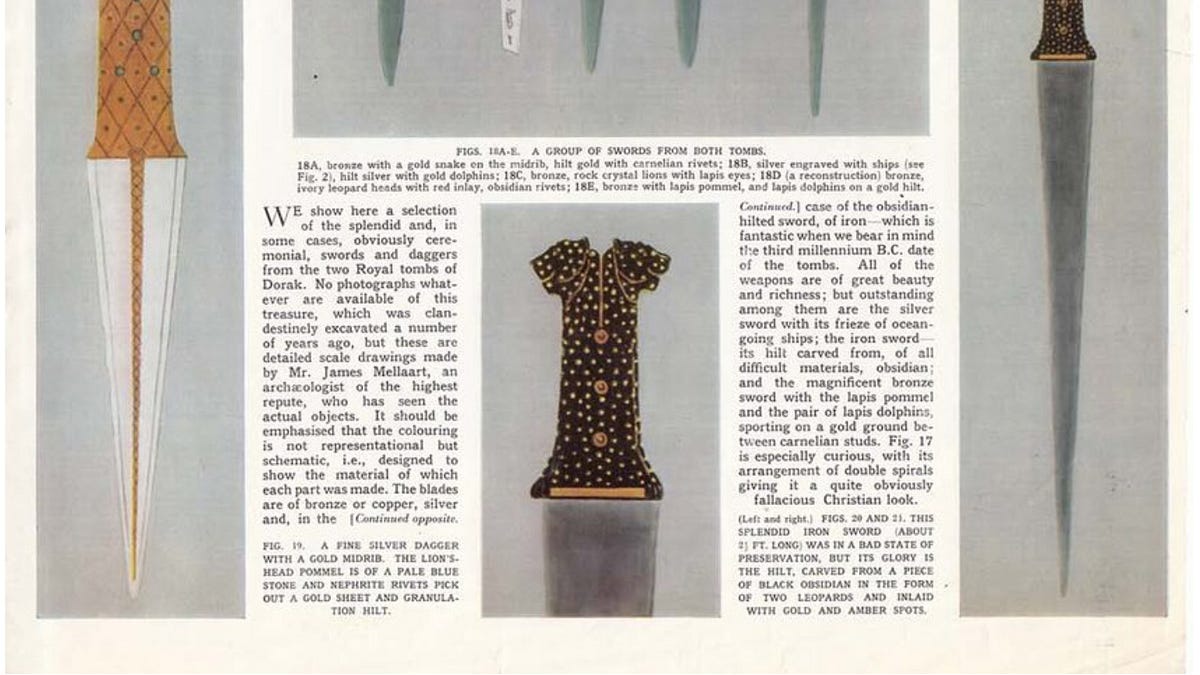
Inside Anna Papastrati's home, Mellaart claimed to have been presented with an astonishing display. He described a chest of drawers brimming with magnificent artifacts. The alleged hoard consisted of an array of dazzling objects crafted from gold, silver, lapis lazuli, amber, marble, and obsidian. Among these were elaborate scepters, intricate bracelets, formidable daggers and swords, ceremonial ax heads, and exquisite vessels, including a particularly noteworthy two-handled gold drinking cup.
Adding to the profound historical significance of the collection, Mellaart reported seeing fragments of a gold sheet that once covered a throne. This fragment bore an inscription in Egyptian hieroglyphics, which tantalizingly referred to Sahure, the second pharaoh of Egypt’s 5th Dynasty (dating between 2450–2325 B.C.). Mellaart surmised that this throne was likely a gift from Pharaoh Sahure to a ruler of the Yortan culture, a civilization that bordered Troy in the mid-third millennium B.C. Such a discovery, if verified, would have profound implications for understanding the geopolitical and trade connections between Egypt and Anatolia during the Bronze Age, potentially rewriting established historical narratives.
Anna also reportedly showed Mellaart old photographs of two tombs near the village of Dorak, which she claimed her family had excavated between 1919 and 1922 – a period when Greek forces occupied parts of northern Turkey after World War I. Mellaart spent several days at Anna's house, meticulously sketching the artifacts and copying the Greek notes inscribed on the photographs. Anna promised to send him actual pictures of the objects, but these never materialized. However, a letter, dated October 18, 1958, did arrive, granting Mellaart permission to publish his drawings. He subsequently published a brief article on these "finds," featuring a page of text accompanied by three pages of his detailed drawings, in the *Illustrated London News*.
From Publication to Suspicion: The Affair Unravels
Mellaart's publication ignited immediate interest, but also a rapidly growing storm of controversy and suspicion. The archaeological community and, crucially, Turkish authorities, demanded to see the actual objects. However, Mellaart could not produce them. His explanation relied solely on the existence of Anna Papastrati and her family's private collection, a collection that no one else ever saw, and a person who could not be located. The address Mellaart provided for Anna in Izmir proved to be fictitious or at least, unidentifiable with an Anna Papastrati or her family.
The Turkish government became increasingly concerned. Allegations of a massive, unverified hoard of artifacts, potentially smuggled or illegally excavated, struck at the heart of national heritage protection. The claim that the items were excavated during a period of foreign occupation (1919-1922) further complicated matters, raising questions of sovereignty and the rightful ownership of cultural treasures. This situation highlighted a critical aspect of archaeological ethics: the imperative of provenance. In archaeology, documentation of an artifact's origin – where and when it was found – is paramount. Without it, objects lack historical context and are often considered of dubious legality or even fake. Mellaart's inability to provide any verifiable evidence beyond his drawings and an uncorroborated story severely undermined his credibility.
The lack of tangible proof for the Dorak hoard, combined with the sensational nature of the story, led many to suspect Mellaart had fabricated the encounter and the objects. While Mellaart steadfastly maintained his account, the damage was done. The scandal became widely known as the Dorak Affair, a name cemented by Kenneth Pearson and Patricia Connor's 1967 book, which delved into the intricacies and controversies of the case. This investigative work, still relevant decades later, chronicles the mounting questions and the ultimate impact on Mellaart's career.
The Geopolitical Fallout: Why Catalhoyuk Paid the Price
For the Turkish government, the Dorak Affair was more than just an academic squabble; it was a matter of national pride, legal integrity, and the protection of cultural patrimony. The implications of an archaeologist claiming to have seen a vast, undocumented hoard of artifacts, purportedly excavated illegally and kept privately, were severe. It suggested either Mellaart was complicit in, or at least knowingly associated with, illegal antiquities trade, or that he was deliberately misleading authorities. Neither scenario was acceptable.
In response to the growing controversy and Mellaart's failure to produce the Dorak artifacts or verifiable evidence of their existence, Turkish officials made a decisive move. They refused to grant James Mellaart permission to continue his world-renowned excavations at Catalhoyuk in 1964. Two years later, in 1966, his application for a permit was again rejected, this time permanently. The Turkish government essentially deemed Mellaart untrustworthy, believing his involvement in the Dorak Affair compromised his standing as a responsible archaeologist. Thus, the groundbreaking work at Catalhoyuk, a site poised to redefine our understanding of the Neolithic era, was abruptly halted, becoming an unwitting casualty of a scandal that continues to baffle historians and archaeologists to this day.
Legacy and Lessons Learned from The Dorak Affair
The cessation of Mellaart's work at Catalhoyuk due to the Dorak Affair serves as a stark reminder of the delicate balance between archaeological discovery, ethical responsibility, and international relations. While the authenticity of the Dorak hoard remains an unresolved mystery, the affair indelibly marked Mellaart's career and cast a long shadow over his undeniable archaeological achievements. For the broader field of archaeology, it became a cautionary tale, emphasizing the critical importance of verifiable provenance, transparent practices, and rigorous documentation.
In the decades following Mellaart's departure, Catalhoyuk lay dormant until new excavations began in 1993 under the leadership of Ian Hodder, breathing new life into the site under a collaborative, multidisciplinary, and highly transparent approach. Today, Catalhoyuk is a UNESCO World Heritage site, and its ongoing exploration continues to yield incredible insights into early human history. The Dorak Affair underscores the profound impact a single, unresolved incident can have on archaeological research, cultural heritage, and the careers of those involved, proving that trust and verifiable evidence are as vital to archaeological progress as the spade itself.